Cotton candy is a common candy delicacy among all of us, attracting both adults and children with its sweet and soft taste, as well as its rich and colorful appearance. The production of marshmallows can not only be done manually but also through fully automated production lines. From raw materials to delicious marshmallows, it only takes a few simple steps to complete. The cotton candy produced by the fully automated production line has a consistent taste and size, making it easy to eat. Let me introduce you to the cotton candy production line, and let’s learn about cotton candy together.
I. Working principle and process of cotton candy production line
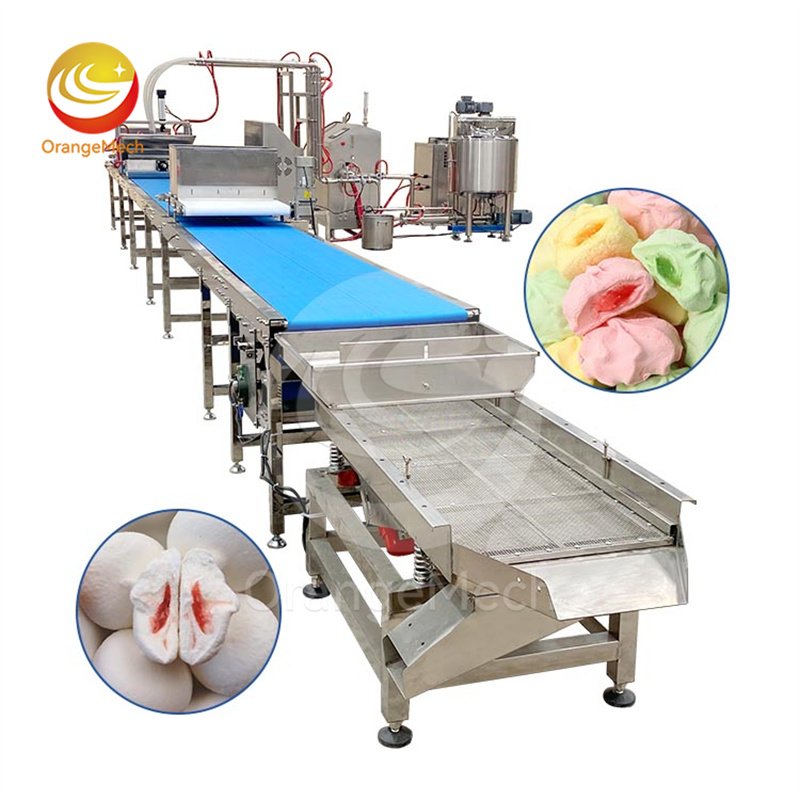
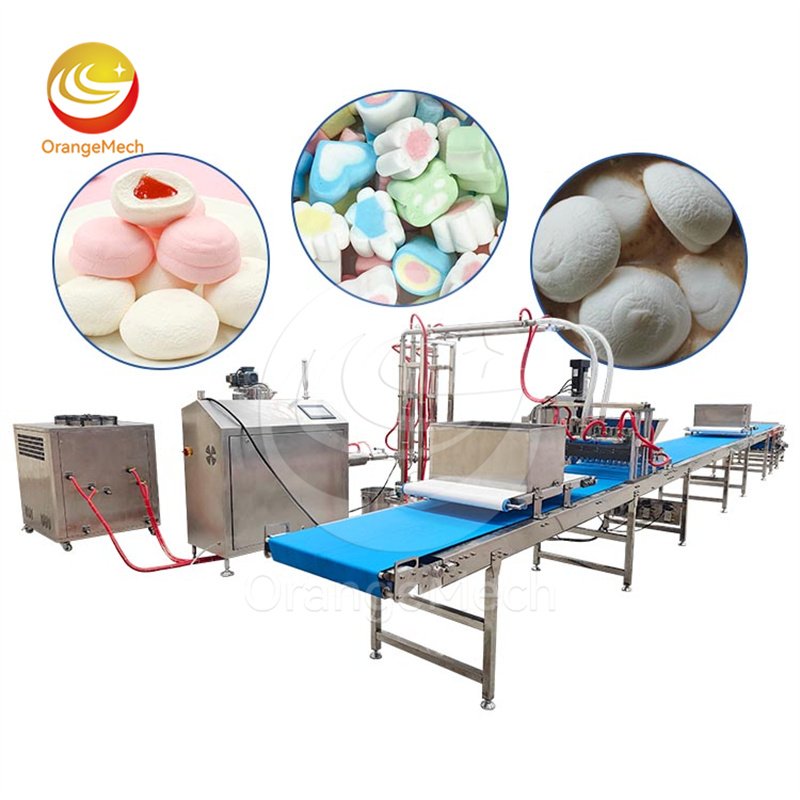
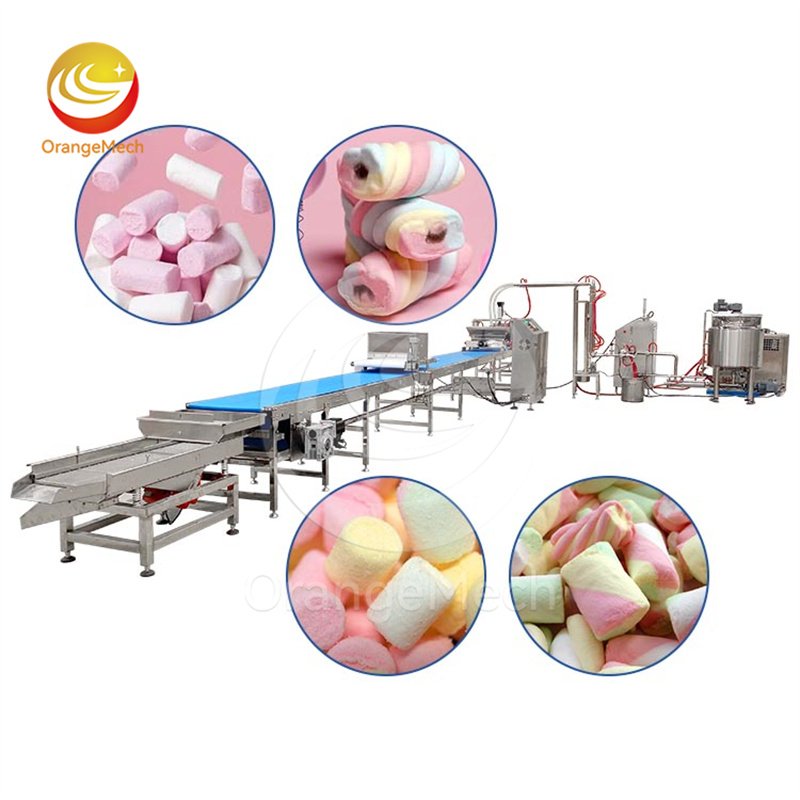
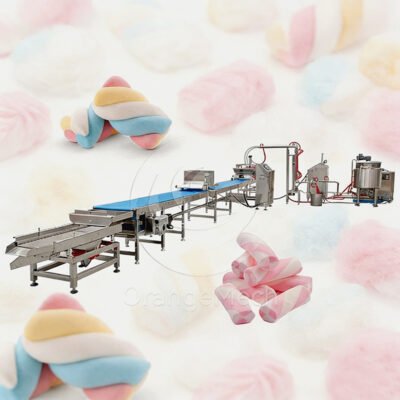
The working principle of the cotton candy production line is to mix and boil raw materials such as sugar, water, and syrup in a sugar pot. The boiled sugar solution is transported to a mixing tank through a pump and pipeline, mixed with gelatin, and fully mixed before being transported to a mixer for continuous high-speed spinning. The slurry is then transported to the pipeline for color mixing through an automatic conveying system and automatically transported to a molding machine for casting into long strips. After powder is sprinkled, it is cut and shaped, and after vibration screening, it is packaged and formed.
marshmallow production process: mixing and boiling for sugar pot – mixing tank – rotary pump – storage tank – rotary pump – mixer – conveying pipe – pouring machine – forming machine – conveyor belt.
II. The basic components of a cotton candy production line
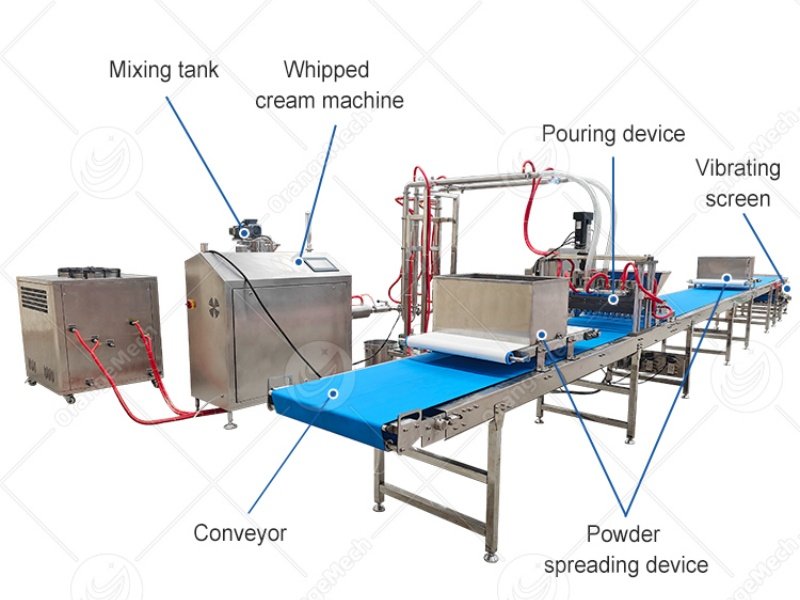
1) The boiling system generally consists of a boiling pot and a mixing tank. The sugar pot is used to heat and melt raw materials such as sugar, syrup, and water to produce a solution of specified concentration. The main body is made of 304 stainless steel material. The heating method can be flexibly configured according to customer energy consumption needs, supporting various forms such as electric heating tubes and combustible gases. The storage tank is used to cache the boiled solution for the next step of use.
2) The shaping system consists of a mixer, a casting molding machine, and a powder spreading mechanism. The function of a mixer is to stir air into the raw material with a high-speed rotating mixer head, causing its volume to expand and its texture to become fluffy and light. The pouring molding machine generally uses a quantitative pouring machine to pour into a mold of a specified shape for molding. Different types of molds can be equipped according to the marshmallow production process to adjust the shape that satisfies customers. The powder-spreading mechanism is to spread white sugar before and after the cotton candy is formed, to prevent the cotton candy from sticking and shaping on the conveyor belt.
3) Subsequently, there will be cutting and forming machines, powder screening machines, and conveyor belts. The cutting and shaping machine is used to cut and piece long strips of cotton candy according to specifications. The screening machine is used to separate excess white sugar from the surface of cotton candy and recycle it for reuse. The conveyor belt transports the cut and shaped cotton candy to the next process for easy packaging.
III. Precautions for Cotton Candy Production Line
1. Please strictly control the raw material ratio and purity according to the characteristics of your product to avoid affecting the molding and taste.
2. When melting raw materials such as syrup and gelatin, it is necessary to continuously stir while heating to ensure that the raw materials are fully mixed evenly. During the high-speed inflation stage, the temperature is controlled at 35-40℃ to allow the material to fully inflate and expand in a fluffy manner. Regularly calibrate the thermometers and timers on the equipment to ensure the accuracy and reliability of the data; adjust the parameters suitable for product production in a timely manner according to changes in environmental temperature.
3. There are risks of mechanical injury and high-temperature burns during the production and processing of the product. All operators must carefully study risk identification, risk prediction, and self-rescue knowledge before using the equipment to ensure their own safety.
4. During the installation process of the equipment, it is necessary to ensure good levelness and verticality and, more importantly, to ensure that the operators have sufficient space for use. Ensure that the operating direction of each mechanical mechanism is correct and smooth and that the pipeline connections are firm, reliable, and leak-free. Ensure that power, water, and gas sources are standardized and correct.
5. After using the equipment, please clean it with hot water in a timely manner to avoid any residue that may affect the use of the machine or the production of the next batch of products. Equipment such as bearings, transmission mechanisms, reducers, and pump bodies should be maintained every 2-3 production cycles.
IV. Summary
The entire conveying system is divided into liquid conveying, pneumatic conveying, and mechanical conveying. Liquid conveying mainly involves the use of rotor pumps and screw pumps to transfer hot and viscous sugar liquid from the boiling system to the whipping system. Pneumatic conveying mainly involves the use of compressed air generated by air compressors to be delivered to the whipping machine to inflate the whipped sugar liquid. Mechanical conveying mainly consists of motors, reducers, etc., which drive the conveyor belt to transport the finished products out.